Koru. Fifty feet of aluminium, still on paper.
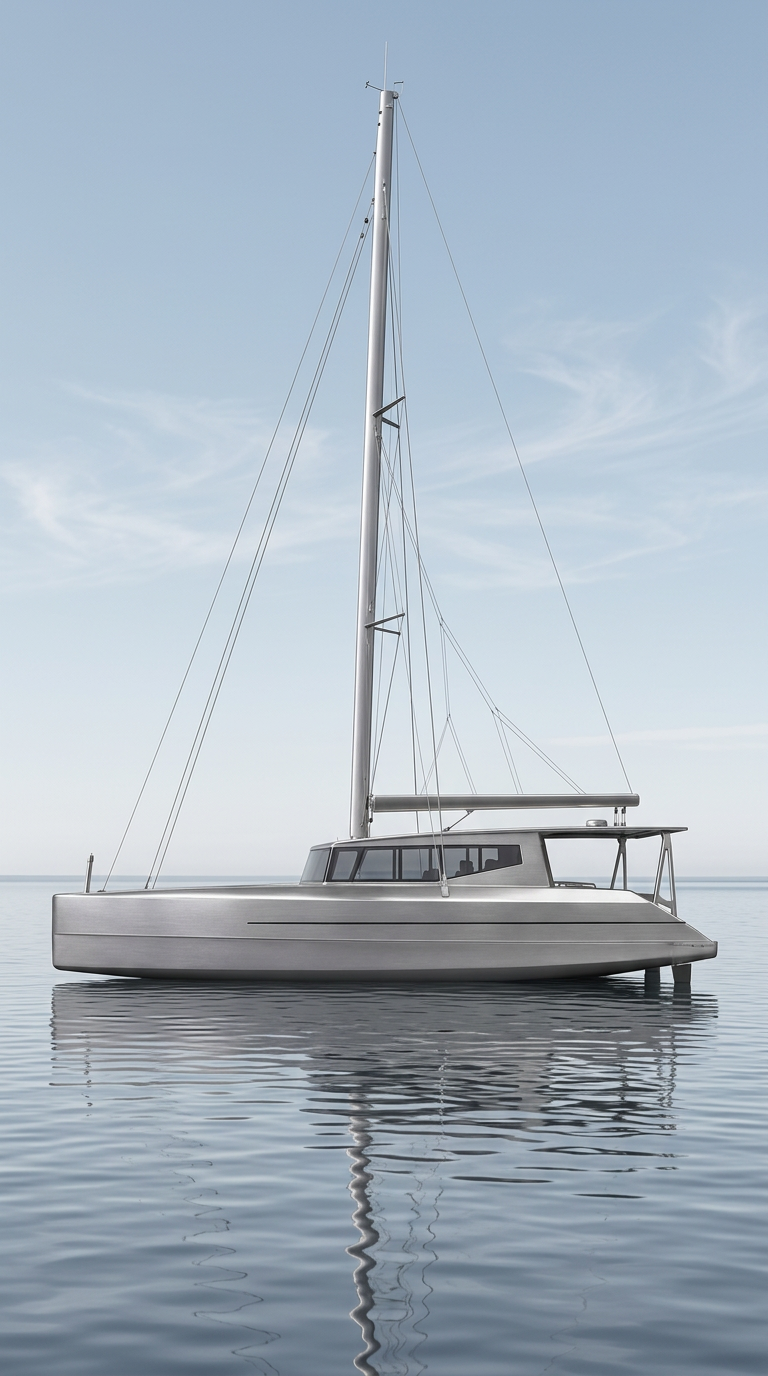
A performance sailing catamaran based on the Mumby 48, customised heavily into a modern liveaboard — without losing the performance we chose the design for. Aluminium hulls, electric motors, 48-volt systems throughout, built in New Zealand.
Below the waterline, she is a Mumby 48.
We are not designing everything from scratch. The hulls come from Tim Mumby's 48, and our builder pays the licences and royalties for that design — credit where credit is due. Even down there a fair amount changes: the builder redrew the whole Mumby for his own boats, and now we have asked him to redraw a lot of it again to make it ours.
She is 4 mm aluminium below the waterline and 3 mm on the deck. That is not made to break icebergs. It is made to be a strong boat for bluewater sailing, which is a different thing.
A naval architect is reviewing the design against Lloyd's standards for aluminium construction. That review is running right now, and it will probably mean changes to the base hull, the structures and the frames. We would rather find those on paper than in the water.
Above the waterline, it is a whole different boat.
The original design was first built in 2003, and boat design has moved on since. Above the waterline is where we live, so that is where nearly all of our changes are.
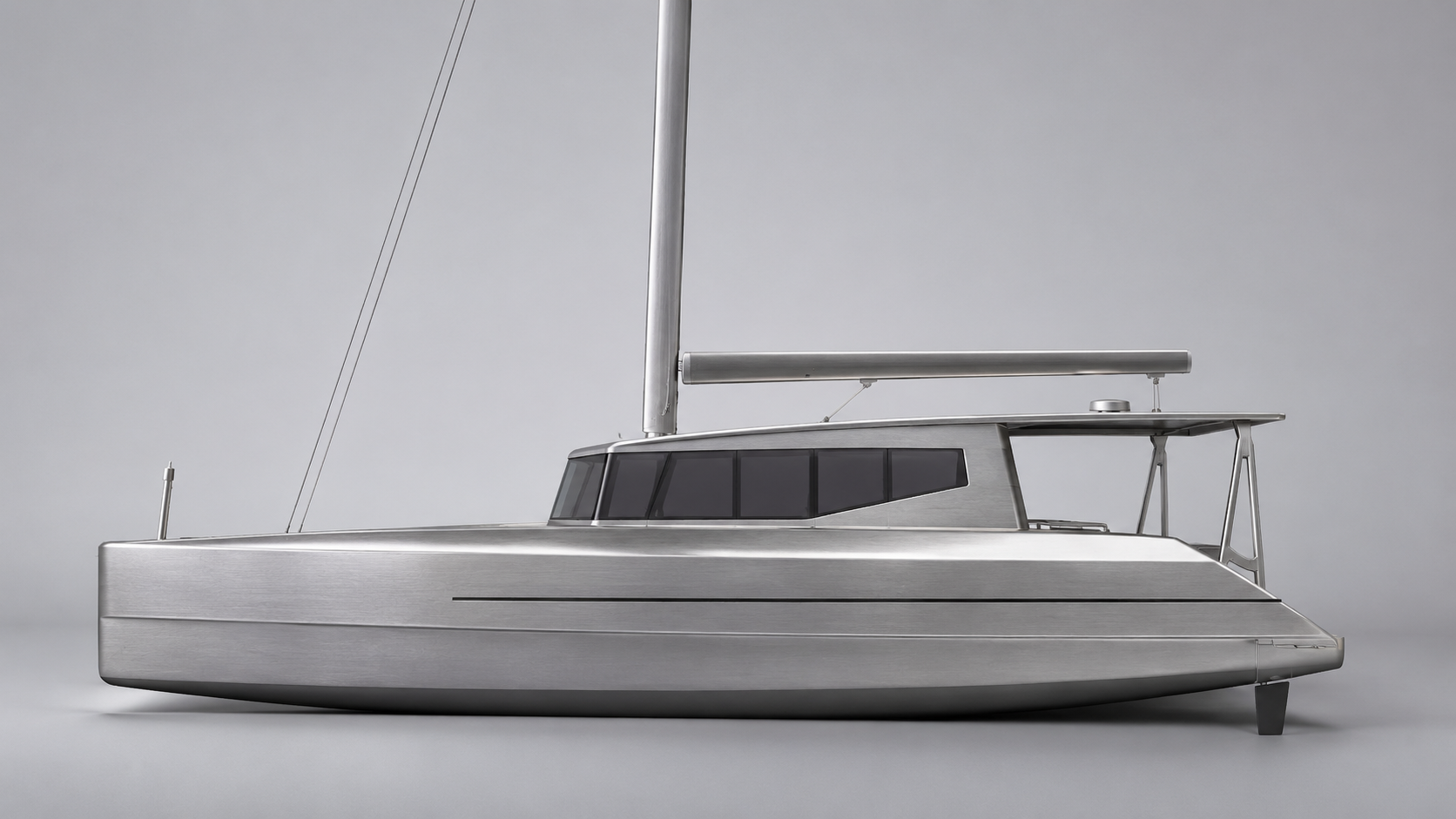
Windows and coach roof. The Mumby has rounded perspex windows that face upwards and soak up tropical heat. Ours go flatter and bigger, and the coach roof comes up a little. Our builder had already drawn it that way, and for a good practical reason: in an aluminium build every rounded corner is manual work. Flat panels get ordered cut to shape, welded in, done — no bending, no difficult welding, less time and less money. Double glazing to keep more heat out is still an open question.
Cockpit roof. Roughly three times bigger than a traditional Mumby's. Partly to get a properly protected cockpit, partly because that roof is where the solar goes.
Galley up. The 48 has the galley down in the hull. Our builder had already designed a galley-up version, and we are reworking it into a U shape so you can step in and see all around you.
Heads midship. The standard Mumby 48 puts both heads and showers right up in the bow, behind the watertight bulkheads. If you have ever used a forward head while beating into a swell, you know exactly what we mean. And in the guest hull as drawn, guests would have to walk through the other cabin to get there. So the guest head and shower move midship — small, shared by both guest cabins, and there for us too when the weather is bad.
The helm was the biggest fight.
The Mumby's steering position sits well inside the cockpit. You cannot see out properly and you cannot see the sails. Our builder's argument was that you put the autopilot on and forget about it. Our argument is that this is a performance catamaran, we intend to sail it, and when you are sailing — around Asia especially — you want to see all around you.
So the steering moves outboard to a traditional raised helm, where you can see everything standing up or sitting on a bench. The roof opens up more above it, with a sliding panel to close when the weather turns or when you are at anchor and do not need to look up at the rig. All the lines come back to the helm; on a standard Mumby some are at the mast, some at the traveller, and tacking means walking to the other side of the boat.
Then the part we are most excited about: a swinging pedestal, so the wheel moves from the exposed raised position down to the protected cockpit level, with engine controls in both places. The inspiration is the VersaHelm on Balance catamarans — their trademark, not ours. We are building ours with one of the Nordic pedestal and steering makers, who answered our fairly hacky email proposal by saying they had a new model coming that fits the case better. We will probably be one of the first boats launching with it. Always worth sending the email.
What we asked to change.
That last one is the most important item on the list, and we are not joking. It is not for the anchor. We have two dogs coming along, they are going to do their business on those trampolines whether we like it or not, and it needs washing away. Every cruiser sailing with dogs is nodding right now.
Under half a million, and we will show you the sheet.
We got a lot of comments that the budget is slim. That is exactly the point. We think you can build a solid, safe liveaboard aluminium boat for less than half a million — not the one, two or three million everyone expects an aluminium build to cost.
Most of it is won in the design. Everything is drawn as cut files: exterior hull shapes, structures, interior. When the build starts, the aluminium is ordered cut to the exact shape and size the boat needs, to the millimetre, so the welding can begin as soon as it lands instead of every single piece being cut by hand. Labour is the expensive part, especially in New Zealand, so that is where the money goes or stays. There will still be back and forth and manual work — there always is.
We are putting the budget into a public spreadsheet so you can follow whether we actually hit it.
Why on earth New Zealand?
We live in Helsinki. The boat gets welded 16,654 kilometres away, and it takes 29 hours on a plane to go and look at it. That question came up a lot.
When we started looking for a proper builder we looked at Thailand, Cambodia, the Philippines, Australia and New Zealand. We preferred New Zealand or Australia. Yes, it is more expensive to build there. The references are more solid, and New Zealand in particular is well known for building aluminium hulls, because that is what their own climate and their own boats demand.
Follow the build